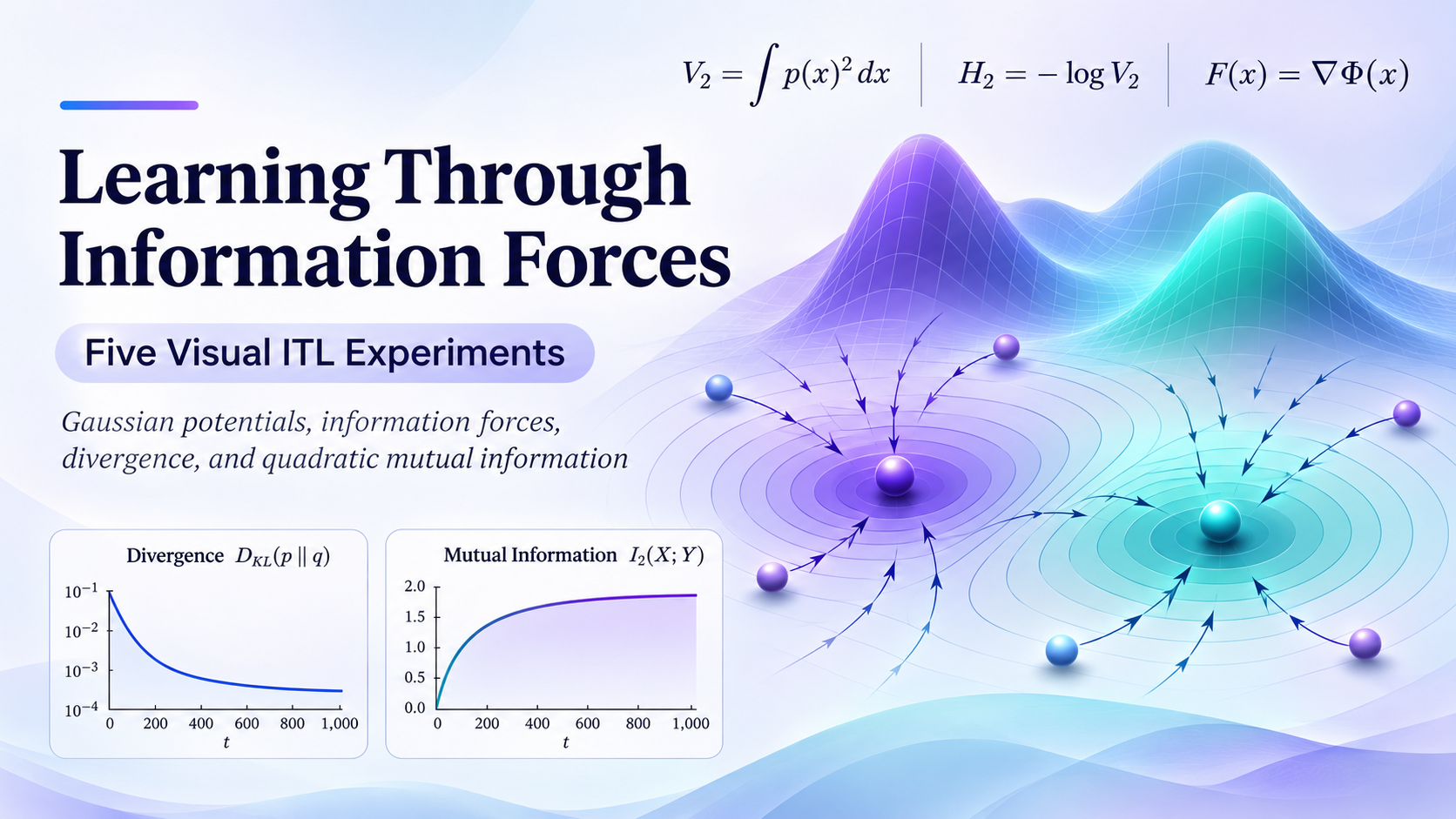
Learning Through Information Forces: Five Visual ITL Experiments
How can a kernel function turn information-theoretic quantities into forces that guide learning? In a new interactive article, I explore the mathematics of Information-Theoretic Learning (ITL), drawing on José C. Principe’s Information Theoretic Learning: Rényi’s Entropy and Kernel Perspectives (2010).
The article presents five computational experiments:
- Gaussian potential fields: how kernel bandwidth changes local information landscapes in one and two dimensions.
- Information-force fields: gradients of kernel potentials, numerical gradient checks, and the connection with mean shift.
- Particle attraction and repulsion: how optimizing quadratic Rényi entropy changes the configuration of data points.
- Distribution matching: minimizing Euclidean divergence between kernel density estimates and comparing with Cauchy–Schwarz divergence.
- Quadratic mutual information: learning a one-dimensional projection that preserves the information in two class labels.
The demonstrations include derivations, figures, optimization trajectories, and results from an executable Python/Colab notebook. In the distribution-matching example, estimated Euclidean divergence decreased from 0.4269 to 0.0304. In the feature-learning example, estimated quadratic mutual information increased from 0.00738 to 0.11835. These values describe illustrative synthetic experiments, not benchmark performance.
Read the full interactive article →
The central idea is simple: by estimating information potentials from pairwise kernel evaluations and differentiating them, we can turn entropy, divergence, and mutual information into optimization objectives with interpretable gradient forces.